


The Payments Modernization Tipping Point: Why Discipline Now Determines Success


For years, payments modernization was defined by experimentation.
Financial institutions added capabilities in response to customer pressure.
A fraud tool here. An instant payment rail there.
A new digital layer to improve experience.
Each initiative delivered value.
Each solved a real problem.
But the architectural blueprint was still evolving.
Today, we have reached a payments modernization tipping point.
Best practices are no longer emerging.
They are stabilizing.
And that changes how senior leaders should approach modernization decisions.
The Payments Modernization Tipping Point Is About Convergence
The tipping point is not about speed.
It is about clarity.
Across the industry, architecture patterns are converging around a consistent model:
Centralized payment hubs instead of rail-specific engines
ISO 20022 as the financial Rosetta stone of modern payments
Real-time data visibility across products and channels
Fraud embedded in flow rather than bolted on
Orchestration that sits above individual rails
Five years ago, these capabilities were aspirational.
Today, they are increasingly assumed.
The Federal Reserve’s Business Payments Study shows that 79 percent of businesses view faster or instant payments as important, and 85 percent expect to be ready within three years business-payments-report. Even small businesses report strong demand signals.
The infrastructure conversation has shifted from whether to how.
That shift marks the payments modernization tipping point.
The New Risk: Rebuilding Fragmentation
When best practices were unclear, experimentation was necessary.
Now the greater risk is not inaction.
It is fragmentation.
Many institutions are still solving locally:
A new fraud module for instant payments
A separate API layer for treasury
A stand-alone disbursement workflow
Data extracts built for individual use cases
Each implementation supports a legitimate business need.
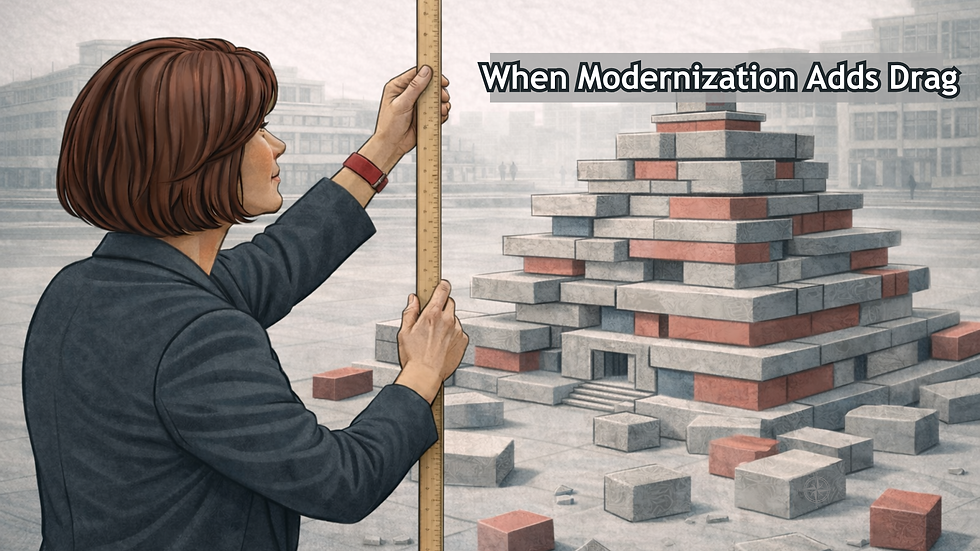
But without a central architectural lens, these decisions compound into modern silos.
Release cycles slow. Data becomes inconsistent.
Fraud controls become reactive instead of preventative.
Liquidity management becomes fragmented.
The technology may be modern.
The structure may not be.
At the payments modernization tipping point, discipline replaces improvisation.
Why Community and Regional Institutions Should Pay Attention
For smaller institutions, modernization once felt like a scale disadvantage.
Large banks could experiment.
Fintechs could move quickly.
Community institutions had to protect capital and manage risk conservatively.
Today, the environment is different.
Payment hubs are maturing.
Cloud-native platforms are standardized.
Fraud orchestration is more accessible.
Implementation cycles are shorter.
Demand is measurable.
Businesses using instant payments report higher satisfaction with their financial institutions business-payments-report.
That is not just infrastructure improvement. It is relationship strategy.
The payments modernization tipping point creates an opportunity for community institutions to compete with coherence rather than scale.
Discipline Now Determines Outcome
Instant payments did not create architectural complexity.
They exposed it.
Irrevocable settlement, continuous availability, and liquidity sensitivity compress operational cycles.
Fraud must move upstream.
Data must be visible in real time.
Orchestration must coordinate across rails.
Architecture is no longer a future initiative.
It is operational infrastructure.
The institutions that recognize this shift will modernize deliberately.
Those that continue modernizing in silos risk recreating the very constraints they intend to escape.
Where the Conversation Moves Next
The architecture phase clarified structure.
The next phase focuses on strategy:
Liquidity as competitive positioning
Composable orchestration across rails
Operational design under continuous settlement
Data visibility as strategic leverage
If you are evaluating your institution’s next modernization move, I recently closed out a deeper architectural series exploring what this tipping point means in practice.
You can read the full analysis here: https://instantpaymentsmaven.substack.com/p/payments-modernization-tipping-point

Comments