


Payments Modernization Challenges: When Modernization Adds Drag

Why Payments Modernization Creates Risk Instead of Flexibility
Modernization is supposed to increase flexibility. Too often, it does the opposite.
Senior leaders across banks and credit unions describe the same experience. Each new capability is approved with the right intent. Each project delivers something tangible. Yet over time, the system becomes harder to change, not easier. Simple enhancements take longer. Data becomes harder to reconcile. Risk conversations become reactive rather than anticipatory.
These are not isolated issues. They are common payments modernization challenges, and they are rarely caused by a single vendor, tool, or legacy system.
They are architectural.
Payments modernization challenges rarely start with technology decisions
Most institutions frame payments modernization as a sequence of technology decisions. Add a fraud platform. Introduce APIs. Enable instant payments. Modernize the user experience. Each step makes sense on its own.
The problem emerges when these decisions are layered onto legacy decision structures that were designed for delay, batching, and downstream control. Over time, the institution accumulates friction that is hard to diagnose and even harder to unwind.
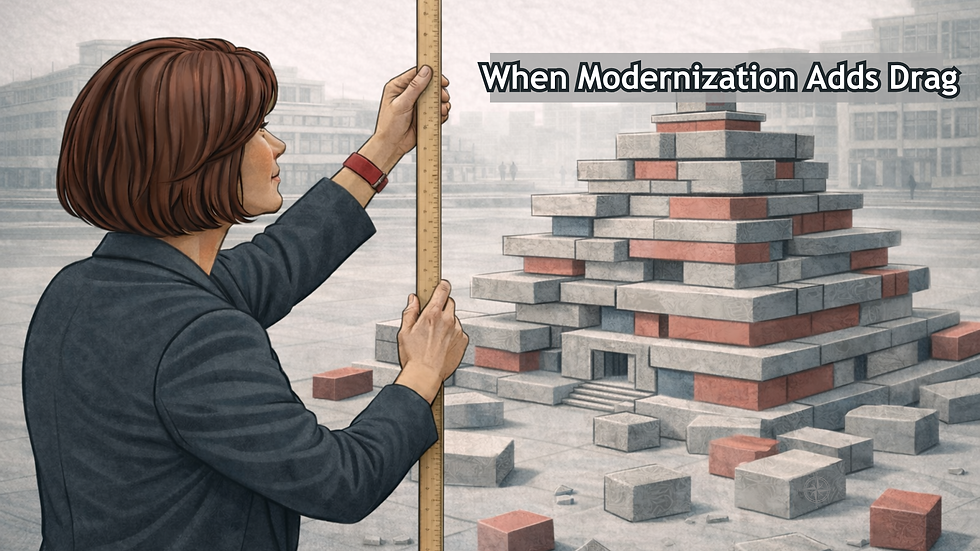
I refer to this pattern as architectural drag. It is the hidden cost that appears when modern capabilities are added without a shared decision architecture.
Architectural drag does not show up in project plans. It shows up later as coordination cost, duplicated controls, conflicting data, and slower innovation.
How architectural drag compounds payments modernization challenges
Architectural drag accumulates incrementally.
A fraud tool improves detection for one channel, but uses a different risk model than another channel.
A payments hub routes transactions efficiently, but cannot apply consistent policy across rails.
An AI pilot optimizes one workflow, but has no shared context with other models in the organization.
Each decision creates a local win. Collectively, they increase enterprise friction.
This is why many payments modernization challenges feel paradoxical. Institutions invest heavily in modern technology, yet change becomes more difficult over time. The issue is not that teams moved too fast. It is that decisions were allowed to fragment.
Why speed exposes architectural weakness
Instant payments, AI, APIs, and advanced fraud platforms are often blamed when complexity increases. That diagnosis misses the real issue.
These transformative capabilities are not driving the challenges. They expose the vulnerabilities of architectures that were never designed for real time decisioning.
Legacy environments relied on time as a safety buffer. Processing windows absorbed uncertainty. Reconciliation corrected errors after the fact. Governance assumed decisions could be reviewed later.
Modern payments remove that delay. Decisions must occur before funds move, obligations are created, or reversibility is lost. When architecture does not change, risk exposure evolves faster than the ability to govern it. That is one of the most persistent payments modernization challenges facing financial institutions today.
Payments modernization challenges are decision architecture problems
Most organizations treat modernization as an integration exercise. How do we connect this tool to the core. How do we wire this vendor into the channel.
The deeper question is often left unanswered. Where does decision authority live.
When fraud, identity, payments, and policy enforcement all make decisions independently, institutions lose coherence. Controls are duplicated instead of coordinated. Models disagree. Customers experience inconsistent treatment across channels.
Solving payments modernization challenges does not require centralizing everything. It requires coordinating decisioning.
Institutions that reduce architectural drag separate decision logic from products and vendors. They establish shared control capabilities that multiple tools can reference. They treat payments and risk as interdependent systems rather than independent stacks.
Composability as risk mitigation
Composability is often discussed as a technology preference. In practice, it is a risk posture.
Composable architectures allow institutions to:
Add new payment capabilities without rewriting core logic
Apply consistent policy across rails and channels
Tune controls as threats and regulations evolve
Modernize in phases without losing sight of the end state
This approach directly addresses payments modernization challenges by ensuring that new capabilities increase optionality rather than constrain it.
Modernization fails not because institutions lack technology. It fails when architecture does not lead.
Leadership responsibility in payments modernization
Architectural drag is rarely created by a single team. It emerges from well intended decisions made without shared architectural ownership.
Leadership in payments modernization is not about selecting tools. It is about ensuring that every tool fits into a coherent system that can evolve safely.
That means asking different questions:
Where do payment and risk decisions occur today
Where is delay masking control gaps
How will new capabilities share data, context, and policy
What must be governed centrally even if execution is distributed
When architectural design leads, payments modernization becomes safer, faster, and more resilient.
If this perspective resonates, the full analysis goes deeper on Substack. I explore architectural patterns, common failure modes, and leadership implications in more detail in Instant Edge.
👉 Read the full piece on Substack: When Modernization Adds Drag


Comments